
5,000 Year Old Art, Newgrange, County Meath
Samhain, the Irish word for “November,” is the beginning of the Celtic New Year, the celebration of Harvest and the beginning of Winter, the Dark Time. Samhain, pronounced “Sow-win,” is often celebrated as a Festival of Fire, and where better to visit than the very place where Samhain originated over 2000 years ago?
As my website explains, the primary purpose of this trip was to visit the thin places of Ireland, those places where the veil between this world and the otherworld is thin, and where people can find peace and healing. The Celts, Druids, and even many people today, believe that veil between the worlds of the living and those who have died is most thin at Samhain, that time when nature cycles into the darkness and period of rest before the spring and rebirth and growth. I wanted to visit the place where celebration of Samhain began.
Traveling with my new friend, Cindi, another of the residents from the Burren College of Art, I drove from Ballyvaughan to Royal County Meath in the east of Ireland. After visiting the Hill of Tara, we made our way to the Hill of Ward, near the town of Athboy, where the tradition of celebrating Samhain began as a festival of fire. Fire was important to the early Celts as it not only pierced the darkness, but embers from the celebratory bonfires that were lit at Samhain were to be taken home to light the hearth for the coming year. As mentioned in an earlier post, the hearth was protected by Brighid or Saint Brigid, and fire remains as a significant symbol for the heart of the home.
On this night, 31 October, my friend, Cindi, and I joined with over 1,000 other people for the walk up the road from Athboy to Tlachtga, the Hill of Ward. People carried torches, lanterns, and flashlights, and there was excitement in the air. Logs that had been split and soaked in kerosene lit our way, as did bonfires that had been built along the mile and a half road to the Hill. Many people paused at the Druid’s Well on the left side of the road, before continuing uphill and then crossing over the stone stile into a pasture.

Leaving Fairgreen, Athboy
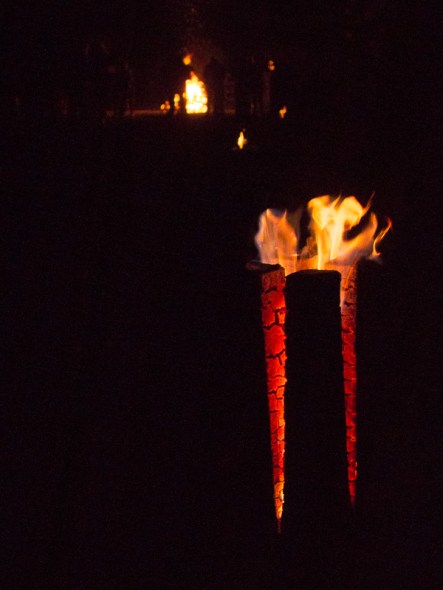
Burning Logs Light Our Way

Druid’s Well
At the top of the pathway, we mixed with the crowd that stood five and six people deep on the bowl-shaped hill that overlooked a clearing where a large fire was burning in a fire pit. Following a brief program explaining the legend of Tlachtga and the observation of Samhain, the names of deceased loved ones were read by the leader or spoken by individuals in the crowd. Finally, pieces of paper on which people had written their intentions, or wishes for those things they wanted to release for the coming year, were placed on the center bonfire and the intentions were consumed by the flames. At the conclusion, the crowd dispersed and we walked quietly back to Athboy, in the darkness, symbolic of the dark time of year into which we were now entering.

The Story of Tlachtga
The celebration at Tlachtga was powerfully moving. I left feeling part of a group with whom I had shared an ancient tradition. In many ways, it was reminiscent of the Christian holiday of Easter with the message of death and rebirth, and the belief that life does not simply end on earth, but that it continues in another realm, even if unseen. The veil, at Tlachtga, was thin that night. And later, when I uploaded my images from that night, I interpreted some pictures as visible reminders that we did not walk alone that night.

Bonfires on the walk to Ward Hill

For more pictures of the Festival of Fire, check this public Facebook page.
A few miles from Athboy is the Hill of Tara, actually the site of several megalithic sites, and not just a single “hill.” The one-hundred acre site is one of Ireland’s most mythic Celtic sites, reported to be the location where the High Kings of Ireland resided. As one website describes, “In ancient Irish religion and mythology, Tara was revered as a dwelling of the gods and an entrance place to the otherworld of eternal joy and plenty where no mortal ever grew old. In the legends of St Patrick’s mission to Ireland he is said to have first come to Tara to confront the ancient religion in its most powerful sight (sic).”
There are several places of interest at the Hill, but the most important is the Lia Fáil, or the Stone of Destiny, atop the Hill of Tara. Legend says the stone was brought to Ireland by the Tuatha dé Danann or “tribe of Danú,” the supernatural race of people descended from the goddess, Danú. As part of the rites of confirmation, when the rightful High King touched or stood on the stone, the stone would roar its approval.
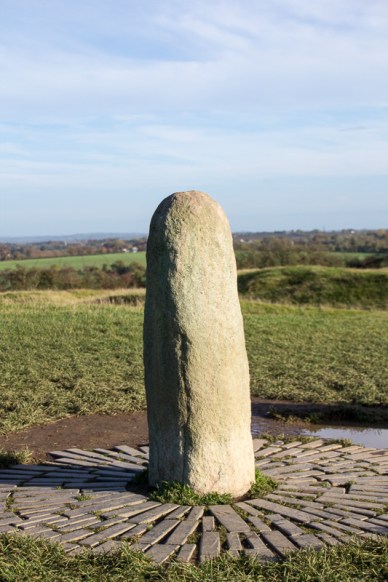
Lia Fáil, Hill of Tara
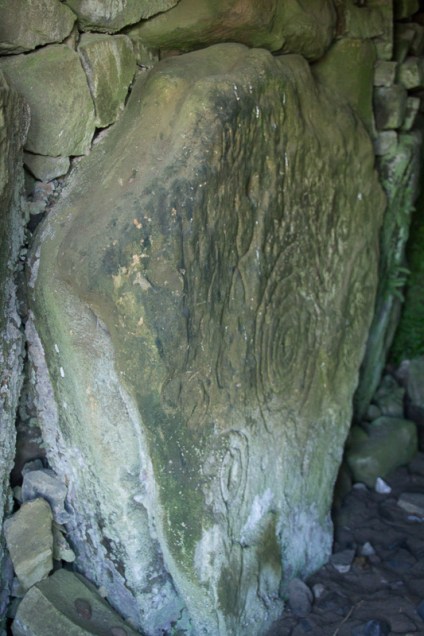
The Mound of Hostages is a Neolithic passage tomb also at the Hill of Tara and it is illuminated at sunrise twice each year, coinciding with Samhain in early November and Imbolc on May 1. Alas, when we went to the Mound of Hostages at sunrise, the hill was shrouded in a heavy mist, so there was no penetrating sun, but another friend shared photographs he had taken of the passage tomb the week before as the sun was beginning its ascent.

Mound of Hostages, Hill of Tara
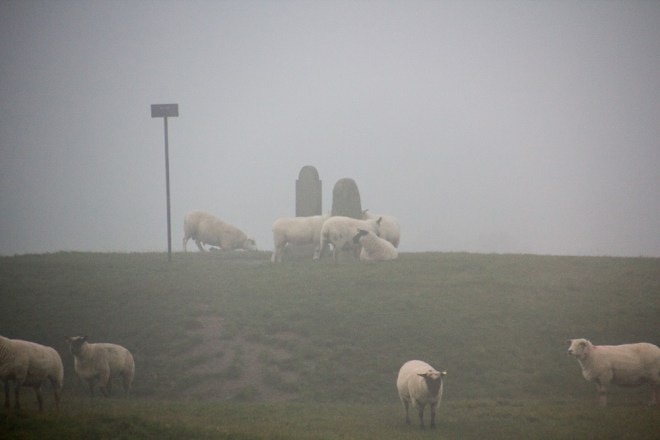
There is no denying the intensity of spirit at this place. My friend actually had a physical reaction when she climbed the Hill of Tara, at the Mound of Hostages, and at the location known as the Banquet Hall. While I didn’t have this type of response, I noticed when we climbed the hill in the early morning mist on November 2, a herd of sheep seemed to be guarding the Lia Fáil while we were there. As soon as we left the hill, the sheep were gone. This is noteworthy because the owner of our B&B told us sheep are never at that end of the Hill in the mornings, but that day, they joined us and kept us at bay, away from the Hill of Tara.

Hill of Tara, County Meath
Also in the Royal County is Brú na Bóinne or Newgrange, a large passage tomb that is remarkable for its astrological alignment with the sun. Built over 5,000 years ago, making it older than Stonehenge in England and the Great Pyramids of Egypt, the 19 meter long interior passage and chamber of the tomb are fully illuminated at sunrise during five days surrounding the Winter Solstice as sunlight passes through a roof-box above the entrance. For more information about this incredible stone-age site, click here. http://www.newgrange.com/ Other passage tombs at both Knowth and Dowth are also located in the Boyne River Valley, but were not open to the public during my November visit, but are also examples of the incredible ingenuity of the ancient people who lived in Ireland.

Another important historical site in County Meath is the round tower at Kells, famous for being near the site where monks hid the Book of Kells, the illuminated gospels created c. 800 AD and now housed at Trinity College Dublin. One of Ireland’s most prized treasures, the beautifully illustrated manuscript has been digitized and is available for viewing online. Click here to view individual pages of the Book of Kells. In the addition to the round tower, some high crosses are in the cemetery in the heart of Kells.
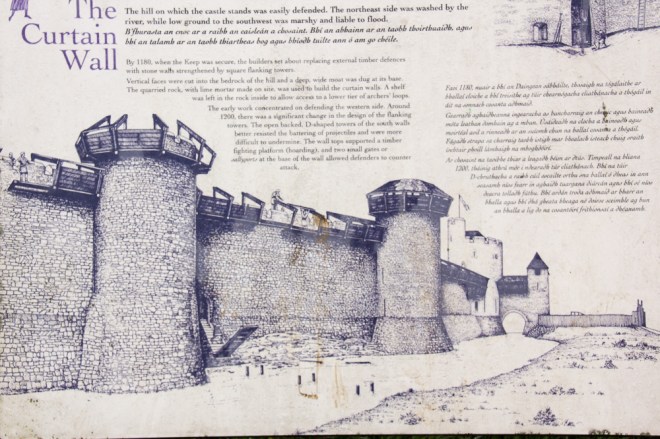
A final site I visited in Meath was the large Anglo-Norman castle at Trim, famously used as a set for filming of the motion picture, Braveheart. Trim Castle is the largest Anglo-Norman castle in Ireland and was built, and rebuilt, during the period from 1172 to 1220 along the southern banks of the River Boyne. The keep is accessible for a guided tour and is remarkably well restored. Its walls are three meters thick, and the keep and other buildings were enclosed by a large curtain wall as well. It must have been an impressive, intimidating structure to the native Irish in the 12th century as England began its domination.

Trim Castle


Royal County Meath’s many sites reveal the mysticism, indomitable spirit, and wisdom of the ancient Celts. The ancestors are here and the veil is thin, if one is willing to be still and listen. I left County Meath knowing I had taken important steps in my personal journey of healing. Being there, especially at Samhain, led me to experience a significant sense of closure as I said goodbye to my beloved, and walked into a season of rest before the eventual new beginnings.





























 Journey to the Thin Places